
- Details
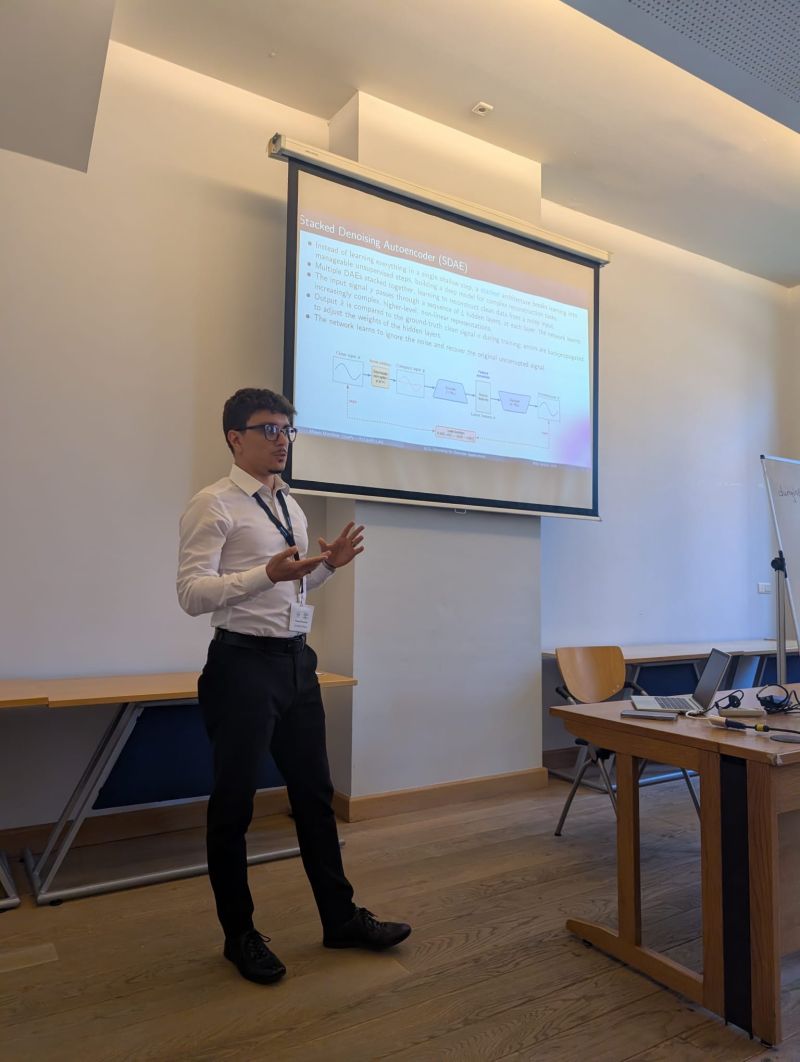
Researchers from the Telecommunications & Remote Sensing Laboratory of the University of Pavia presented two research contributions at the 14th IEEE International Conference on Wireless for Space and Extreme Environments (WiSEE 2026), held in Leuven, Belgium.
The first work, “A Comparative Study of ECG Denoising Methods for Wearable Applications,” was presented during the Wireless Communication and Sensing for Humans and Living Systems in Space (WiLS-Space) Workshop.
The paper, authored by Bamrung Tausiesakul, Anna Marcucci, Amin Damrah, Mauro Marchese, Pietro Savazzi, and Anna Vizziello, investigates signal-processing techniques for improving the quality of ECG signals acquired by wearable devices. In particular, the study compares several state-of-the-art denoising methods using real upper-arm ECG recordings, a comfortable but challenging measurement location because of motion artifacts and reduced signal quality.
The different techniques were evaluated in terms of both signal-to-noise ratio improvement and preservation of the QRS morphology, providing useful indications for the design of reliable wearable systems for continuous physiological monitoring, including Wireless Body Area Network applications during space missions.
A second contribution, “Power Reduction in Heterogeneous Wireless Sensor Networks via Source-Aware Allocation,” by Mauro Marchese and Pietro Savazzi, focused on improving the energy efficiency of heterogeneous wireless sensor networks operating in space and extreme environments.
The proposed approach introduces a source-aware resource allocation framework in which transmission power and bandwidth are assigned according not only to communication-channel requirements but also to the intrinsic complexity of the physical information generated by each sensor.
The work derives an information-theoretic lower bound on the SNR required for source reconstruction based on the Rényi information dimension (RID) and exploits this metric to jointly optimize power and bandwidth allocation. Simulation results show that taking the characteristics of the transmitted source into account can provide significant power savings compared with conventional source-independent allocation approaches.
Together, the two contributions highlight the broad research activities of the TLC Lab in the field of communications and sensing for space and extreme environments, ranging from energy-efficient wireless sensor networks to wearable biomedical signal processing.
- Details
Next Tuesday, 25th July, our colleague prof. Anna Vizziello will give a seminar on her research activities, titled "A New Frontier for Wireless Networks: Intra-body Communication and Sensing for Biomedical Applications". The seminar will be held in person at the Institute for the Wireless Internet of Things of Northeastern University in Boston, Massachusetts, and can also be watched online. The scheduled time is 11:30 am - 12:30 pm ET / 17:30 - 18:30 CET.
More details at the event page:
https://mailchi.mp/
- Details
We're very glad to announce that our colleague prof. Paolo Gamba has been elected a Member of the Academia Europaea.
Being recognized as a Member by the Academia Europaea means joining a group of exceptional scholars and researchers who are shaping the future of Europe's academic landscape.
Our group is very proud of the achievement by our colleague, and look forward to the opportunities that will open of meaningful collaborations and deeper knowledge sharing by leveraging a platform that fosters collaboration and excellence across various disciplines.
Congratulations to Paolo!

- Details

In March 2022, the University of Pavia activated a university-wide license for the use of data from the Planet Labs constellation. The license supported research activities in three different Departments: the Department of Industrial and Information Engineering (DIII), the Department of Earth and Environmental Sciences (DSTA) and the Department of Civil Engineering and Architecture (DICAR).
In anticipation of the renewal of the license, with the addition of even higher spatial resolution data, the researchers who worked on this data have decided to present their work, to allow those interested to understand the potential for use and facilitate the birth of inter-university collaborations.
Sala Riunioni Magenta – DIII e online
https://us02web.zoom.us/j/
27 gennaio 2023, ore 10:00 – 13:00
Programma
Institutional greetings – V. Annovazzi Lodi (Deputy Director of DIII), A. Reali (Director of DICAR)
The data of the Planet constellation and their availability for research at the University of Pavia – P. Gamba, Coordinator of the Planet @ UNIPV license
Planet Labs constellations and data sets – T. De Souza Ferreira (Planet Labs Europe)
Analysis of the state of vegetation using PLANETSCOPE data in the Canary Islands – D. Rodriguez Esparragon, P. Gamba (DIII)
Use of Planet data in agriculture: study of the radiometric congruence of repeated acquisitions – C. Baldin, V. Casella (DICAR)
Severe drought in Northern Italy and floods in the Argentine pampas: examples of environmental monitoring with Planet and radar data – D. Marzi, D. Rodriguez Esparragon, P. Gamba (DIII)
The use of Planet Images in Engineering Geology – V. Vivaldi, C. Meisina, M. Bordoni (DSTA)
DEM and surface deformation mapping with PLANETSCOPE (plus other amenities) – F. Zucca, R. Seppi (DSTA)

- Details
Today 1st of January 2023, prof. Paolo Gamba takes the role of Editor in Chief of the IEEE Geoscience and Remote Sensing Magazine (GRSM). GRSM is a reference journal for the IEEE Geoscience and Remote Sensing Society (GRSS); it is freely available to all GRSS members on IEEEXplore, including many tutorials to improve knowledge about specific GRS-related topics. All our group congratulates with prof. Gamba for his great achievement and wish him successful developments with his new role with the Magazine!